Community resilience…and data
There have been some amazing COVID19 responses across the region…
In July and early August, the MainStreet team supported the Data-Driven Innovation Initiative (part of the Edinburgh and South East Scotland City Region Deal) and colleagues from the Scottish Futures Trust with a “community resilience & data” project. Its aims were to identify community data use in responses to the COVID19 lockdown throughout the Region, and to contribute to thinking on how data can be used to support infrastructure needed for resilient future cities, towns, and villages.
Over the course of 6 weeks, we spoke with 40+ organisations across Fife, the Lothians, Edinburgh City and the Scottish Borders – finding out how they and the communities they serve have responded to the pandemic locally, and about their use of data.
It was an absolute privilege to be involved with it.
We got to hear about loads of inspirational community-led projects – from informal volunteer-led mutual aid groups in streets and villages, through to large-scale multi-partner programmes in towns and cities – all responding to vulnerabilities exposed or exacerbated by the COVID19 pandemic.
But lessons for communities, local and national government
Much of the successes seem to be from the relative agility of respective partners – an ability to get moving quickly in early March, “getting the sleeves rolled up and getting on with things”, not needing to ask for permission, and exploiting existing good networking and relationships locally. Indeed, communities with anchor organisations and longstanding, visible voluntary sector presences were very prominent in the fieldwork. A reminder again that our ‘third sector’ often shows up first…
But interesting too were examples in the Borders, East Lothian, Midlothian and (in some areas of) Fife, where pre-existing resilience groups for bad weather or other civil emergencies were key: these structures and relationships were already in place and able to flex to meet the need for local COVID19 responses.
The interventions themselves were predominately in:
- Coordinating emergency food parcels
- Preparation & delivery of hot or fresh food
- Collecting & delivering prescriptions and shopping
- Befriending, checking in on vulnerable groups
- Supporting people with mental health challenges.
What was interesting to us was that most of these interventions were (and continue to be) run in every area: while the extent and volumes of hunger and mental health challenges are more pronounced in places with low SIMD rankings, social isolation, medicine and food delivery vulnerabilities have also been exposed by COVID19 even in relatively affluent areas. And in some of our most rural areas (and there are many outside of the City of Edinburgh), digital and transport connectivity challenges compound delivery and social isolation issues.
It’s worth noting too that the very physical impact of lockdown has caused real frustrations: in less affluent areas, the closure of libraries and community centres and restrictions on parks and play areas reduced access to trusted public spaces.
And data – no matter how informal – has been playing a part
The issue of ‘community data’ use wasn’t straightforward on the project. Many of the groups and individuals we spoke to (across all areas and demographics) do not yet consciously or deliberately think in terms of ‘data’ or ‘data infrastructure’ – its creation, use, sharing – and they were clear that it has not been a priority during the pandemic.
But when prompted, it’s also apparent that those involved in community resilience initiatives are creating data informally, quite often via WhatsApp or Facebook Messenger; are in some instances sharing or repurposing information from other organisations; and would use certain community datasets if accessible. These three categories is shown in the diagram below:
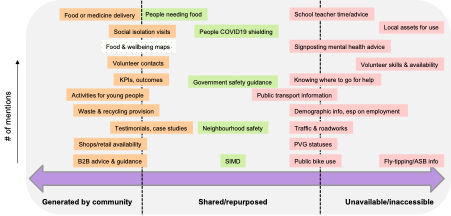
Our initial view is that there is a disconnect between communities and community groups’ data needs, and what is being created and published elsewhere for use by national and local government. But there is lots of data created, used and shared by all community partners – and it’s a two-way process – but its informal, qualitative nature means that it is not necessarily seen as such at this stage.
Moving on from those attitudes, and addressing wider awareness and accessibility concerns (through training, tools showcasing, use of incentives etc), is needed to ensure the development of useful local data infrastructure.
Policy and decision-makers now need to play their part…and quickly
Our report concluded with a series of considerations not just on the data but on the wider placemaking infrastructure required to support place-specific interventions and investment in the development of resilient future cities, towns, and villages.
To structure that, we used the PlaceStandard tool used by the Scottish Government as a way of assessing places. The COVID19 pandemic and our communities’ responses to it has implications for every one of the 14 elements of that tool, and in how we develop places better equipped to deal with future pandemics or emergency events (including from climate change). It may be too that governments – both local and national – decide to prioritise funding differently on the back of our experiences in 2020.
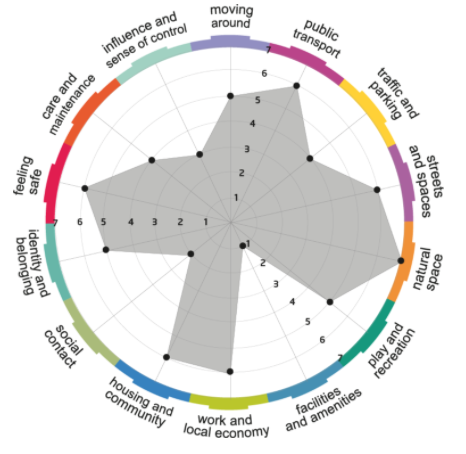
The key point though is a need for speedy consideration and decision-making. All of our interviewees (in every area, and in every demographic) said that bigger challenges lie ahead. Autumn and winter 2020 will likely see emergency state and volunteer support reduce, at the same time that unemployment, debt, food insecurity, stress and mental health issues will likely grow.
Our communities and community groups across the region deserve better than having to do more of the same thing again.